Blog
From Artwork to Finished Shirt: What Really Happens Inside a Las Vegas Screen Printing Shop
10/05/2026
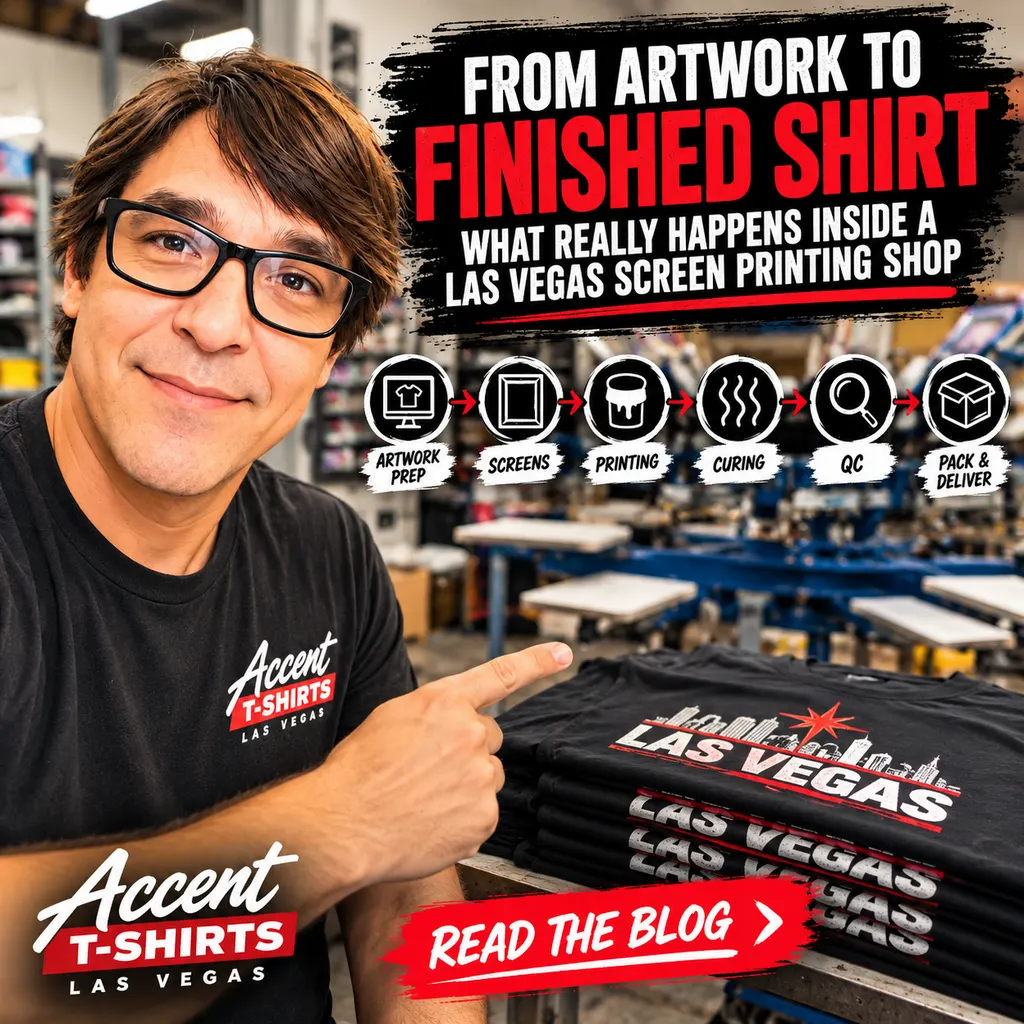
From Artwork to Finished Shirt: What Really Happens Inside a Las Vegas Screen Printing Shop
You approved the quote. You approved the artwork. You made the payment.
So what happens next?
For most customers, this is the part of the process they never see. A custom T-shirt order may look simple from the outside, but once an order is approved, there are several production steps that happen before those shirts are ready for pickup or delivery.
At Accent T-Shirts in Las Vegas, every order moves through a production process designed to make sure the finished apparel looks right, prints correctly, and matches the approved artwork.
Hereâs a behind-the-scenes look at what happens after you hit approve.
1. Your Order Moves Into Production
Once the artwork, quantities, garment styles, sizes, and payment are approved, the order can move into production.
Before anything is printed, the details are reviewed again.
That includes garment colors, print locations, artwork size, ink colors, quantities, sizes, and any special instructions.
This is also why it is important to carefully review your proof before approving it. Once production begins, changing artwork, shirt colors, quantities, or print locations can affect both pricing and turnaround time.
2. The Artwork Is Prepared for Printing
Customer artwork is not always immediately ready to go onto a screen.
Our production team checks the artwork to make sure it will reproduce correctly on the garment.
Depending on the design, this may include separating colors, adjusting line thickness, cleaning up small details, preparing underbases for dark garments, or making sure the artwork is sized correctly for the print location.
A design that looks great on a computer screen still has to work with real ink, real fabric, and real production equipment.
That is one of the reasons properly prepared artwork makes such a difference in the finished product.
3. Screens Are Created
For traditional screen printing, each ink color generally requires its own screen.
The artwork is separated by color and transferred onto coated mesh screens. Those screens are then exposed and washed out, leaving open areas where the ink will pass through during printing.
A one-color design may only need one screen.
A multi-color design can require several screens, all of which must line up correctly on the press.
This alignment process is called registration.
Good registration is what keeps the different colors in a design lined up instead of looking shifted or blurry.
4. Ink Colors Are Prepared
Once the screens are ready, the ink is prepared.
Some jobs use standard stock colors, while others may require specific colors based on the artwork or brand requirements.
The ink also needs to work with the garment color.
Printing white ink on a black shirt, for example, is different from printing dark ink on a white shirt. Dark garments often require an underbase so the colors stay bright and visible.
Fabric type can also affect how ink behaves.
Cotton, polyester, blends, performance fabrics, and specialty garments may all require slightly different production considerations.
5. The Shirts Are Counted and Staged
Before printing begins, the garments are counted, sorted, and staged by size and style.
This may sound like a small step, but it is an important one.
An order could include multiple shirt styles, different colors, youth and adult sizes, long sleeves, hoodies, or multiple print locations.
Keeping everything organized before production helps reduce mistakes and keeps the job moving efficiently.
6. The First Print Is Checked
Before running the entire order, we typically inspect the first print carefully.
This is where the production team checks placement, registration, ink coverage, artwork size, and overall appearance.
If something needs adjustment, it is much better to catch it on the first shirt than after dozens or hundreds have already been printed.
Once everything looks right, the full production run begins.
7. The Shirts Are Screen Printed
Now the shirts move onto the press.
Each shirt is loaded onto a printing station, and each ink color is applied through its corresponding screen.
On multi-color designs, the shirt moves through several print stations.
Some colors may also require a quick flash cure between layers before another color can be printed on top.
Depending on the artwork, garment, and quantity, this process may repeat hundreds or even thousands of times.
8. The Ink Is Cured
Fresh screen-printing ink is not finished just because it looks dry.
The ink must be cured at the correct temperature so it properly bonds with the garment.
After printing, shirts travel through a conveyor dryer where they are exposed to controlled heat.
Proper curing is one of the most important parts of the screen-printing process.
If ink is not cured correctly, it can crack, peel, or wash out prematurely.
A properly cured screen print should hold up through regular wear and washing.
9. Quality Control
After production, the order is checked again.
We look for issues such as poor ink coverage, incorrect placement, misregistration, printing defects, or garment problems.
Because custom apparel production involves both machinery and individual garments, quality control is an important final step before an order leaves the shop.
The goal is simple: make sure the order you receive matches what was approved.
10. Folding, Boxing, and Final Count
Once the shirts pass inspection, they are counted again and prepared for pickup or delivery.
Depending on the order, shirts may be folded, bundled, boxed, separated by size, or prepared according to customer instructions.
For larger events, conventions, schools, businesses, and organizations, careful sorting can save customers a lot of time once the order arrives.
11. Pickup or Delivery
Once production is complete, the order is ready for pickup or shipment.
Accent T-Shirts works with businesses, schools, organizations, events, conventions, teams, and individuals throughout Las Vegas and beyond.
Local customers can pick up directly from our Las Vegas shop, while many orders can also be shipped or delivered depending on the project.
Why Turnaround Time Starts After Approval
One of the most common questions we receive is:
"When will my shirts be ready?"
Our normal production lead time is generally based on the point when the order has been fully approved and paid.
That means final artwork, garment selections, quantities, sizes, and payment all need to be completed before production can officially begin.
Last-minute artwork changes or quantity changes can sometimes restart part of the process.
That is why approving everything early is one of the best ways to keep your order on schedule.
There Is More Behind a Printed Shirt Than You Might Think
When you receive a finished custom T-shirt, you are seeing the final result of multiple production steps.
Artwork preparation, screen creation, ink preparation, garment staging, registration, printing, curing, inspection, counting, and packaging all happen behind the scenes.
At Accent T-Shirts, we have been producing custom apparel for businesses, organizations, events, and customers in Las Vegas since 1999.
Whether you need 24 shirts for a local business or hundreds of shirts for a convention or event, our goal is to make the ordering process straightforward while handling the production details behind the scenes.
Ready to start your next custom apparel order?
Visit AccentTShirts.com or call 702-866-8888.
Accent T-Shirts
2545 E. Chandler Ave., Suite 11
Las Vegas, NV 89120
MondayâFriday, 9 AMâ5 PM
Written by Lindy Williams