Screen Printing
The History of Screen Printing: Origins, Evolution, and Cultural Significance
Screen printing, originating in ancient China, has evolved into a dominant method for textile and artistic printing. From its 1960s boom to modern-day businesses like Accent T-Shirts in Las Vegas, this technique remains a staple in custom apparel and creative expression.
Screen printing â also known as silk screen printing or serigraphy â is a technique of pushing ink through a woven mesh stencil to create a printed design. This method has a surprisingly long history, tracing back over a thousand years, and it has seen periods of widespread popularity at different times in different cultures. Today it remains one of the most prevalent methods for printing graphics on textiles and other materials, from art prints to T-shirts
Ancient Origins in Asia
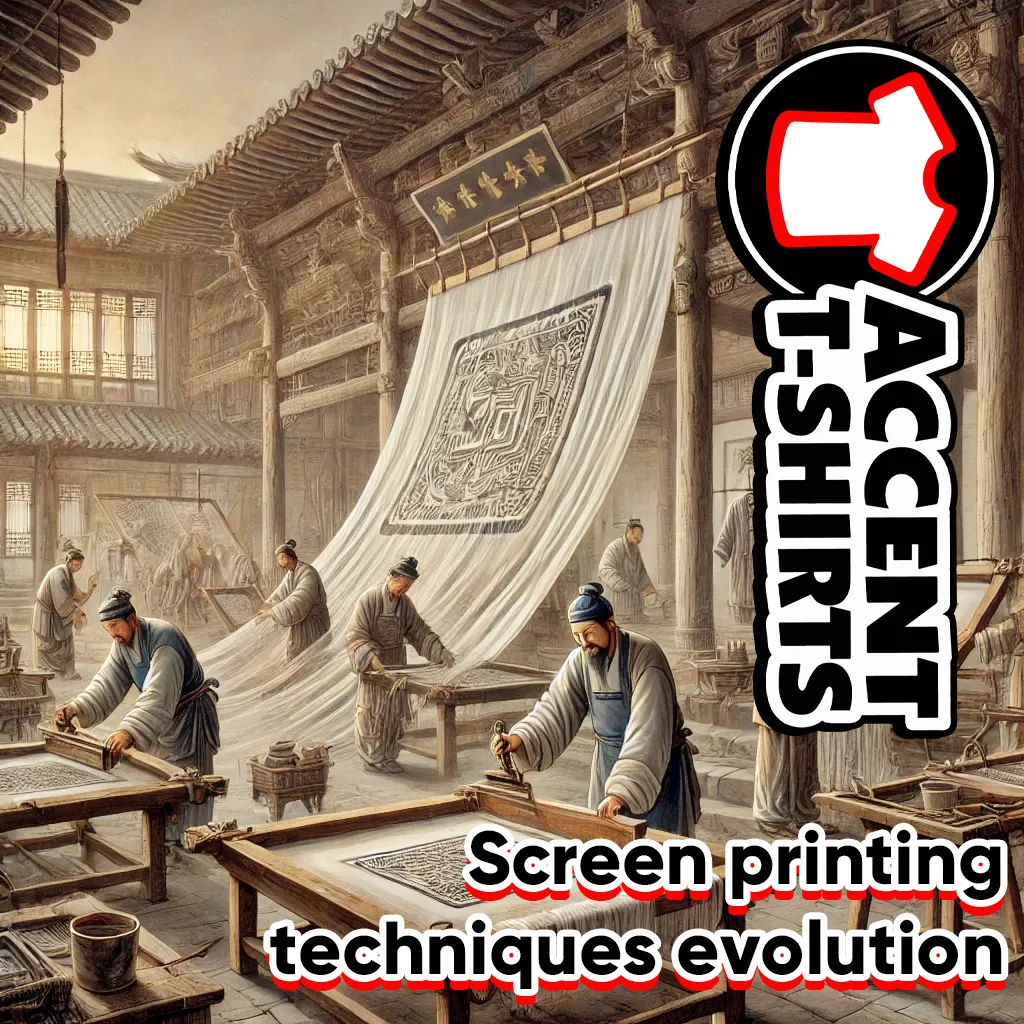
The roots of screen printing reach back to ancient Asia. Most historians agree the technique first appeared in a recognizable form in China during the Song Dynasty (960â1279 AD)
Early Chinese screen printing used silk fabric as a mesh stretched tightly, with hand-cut stencils (often made of tough, waterproofed paper) to mask out designs.
Artisans would glue the stencil to the silk screen and force ink or paint through the open areas of the mesh, transferring intricate images onto textiles or paper.
This ability to reproduce designs with precision was a major artistic advancement of the era,.Allowing for decorative fabrics and artworks that were otherwise extremely labor-intensive to create by hand.
From China, the method spread to Japan and other neighboring countries over the subsequent centuries.
Japanese craftsmen refined the process in unique ways â for example, using human hair to weave the mesh before silk was readily available, and developing a specialized art of stencil cutting known as katagami.
In the katagami technique, multiple layers of washi paper were bonded with natural glue and intricately cut into patterns; these delicate stencils were then reinforced with a fine silk or hair mesh, allowing repeated use for dyeing textiles like kimonos.
This approach was so effective that it became an important cultural art form in Japan (now recognized as an Important Intangible Cultural Property), demonstrating that the concept of pressing ink or dye through a screen stencil had firm roots in East Asian art and craft.
.
Even before the formalized silk screen method, stenciling techniques that foreshadowed screen printing were used in other parts of the world. For instance, anthropologists have found evidence of prehistoric stencil art where early humans blew pigment around hands pressed on cave walls, essentially using hands as stencils. In the Pacific Islands, some indigenous peoples forced dye through cut banana leaves to print patterns on bark cloth.
These examples show that the basic principle â pushing pigment through a shaped mask â has been intuitively discovered in various forms long ago. However, it was in China and Japan that the method truly evolved into using a woven mesh (originally silk) combined with stencils, which is why screen printing is often historically referred to as âsilkscreenâ printing.
By the Middle Ages, screen printing (silk screening) was widely practiced across China, Japan, and much of Asia in these various forms.
This would change once trade routes like the Silk Road made silk mesh more accessible to Europeans, and as Western artisans and industries discovered profitable uses for the method.
Introduction to the West and Early Use
Screen printing was first introduced to Europe in the 18th century as travelers and traders brought back knowledge of Eastern printing techniques.
However, early adoption was slow â silk was an expensive imported material, and European printmakers initially preferred traditional methods like block printing or lithography for most purposes. It wasnât until silk became more readily available through trade, and innovators began adapting the method, that screen printing started to gain traction in the West.
By the mid-19th century, with the Industrial Revolution in full swing, Western manufacturers began to see the value of screen printing for certain applications. France provides an early example: artists there used silk screens stretched over frames to print patterns onto fabric, an approach that grew in popularity as mechanization improved.
Because of the cost of materials and labor, these silkscreened goods â ornate wallpapers, linens, and silk fabrics â were initially available only to the wealthy.
Nonetheless, these early uses demonstrated the commercial potential of the technique in producing vibrant, repeatable designs.
A milestone in the West was achieved in 1907 when Samuel Simon of Manchester, England, patented the first modern screen printing process.
This 1907 patent is often credited as the birth of modern screen printing in industrial terms. Simonâs technique was quickly adopted in England and Europe for printing upscale items like wallpaper, signs, and fabrics, but it remained a relatively specialized craft at that time.
Notably, Simon was not alone â other inventors were concurrently experimenting and filing patents for similar stencil-printing machines in the early 1900s.
For example, a Frenchman, Antoine Véricel, had patented a carousel-style multicolor screen printing press as early as 1902.
These early patents laid the groundwork for what would become the screen printing presses of the 20th century.
Technological advancements soon followed to make screen printing more efficient and detailed. In the 1910s, a group of American printers (Roy Beck, Charles Peter, and Edward Owens) revolutionized the stencil-making process by introducing photo-reactive chemicals.
They discovered that coatings of potassium or ammonium bichromate mixed with gelatin could be used to create a light-sensitive emulsion.
Although it took years for the industry to fully embrace photo-stencils (early sensitizers were toxic and finicky), this innovation was the precursor to the photographic stencil systems used by screen printers throughout the 20th century and up to today..
As screen printing methods improved, their use in commerce expanded. In the United States, by the 1910s and 1920s screen printing began to take off as a practical printing method for signage and promotional materials. One early example was the production of felt pennants (such as college or sports pennants) â companies on the West Coast like the Brant & Garner Company of San Francisco started using screen printing to mass-produce colorful pennants and posters.
By 1915, another firm called Selectasine not only created large-format screen printed posters but also marketed the screen printing process itself, selling some of the first commercial screen printing kits and presses to other printers.
This marked the beginning of screen printing as an industry in its own right in America. The trend spread: by the early 1920s, screen printing had also become more common in Europe, no longer confined to luxury goods â it was being used for things like advertising displays and product packaging, wherever bold graphics were needed.
.
Screen Printing as Art and Wartime Tool (1930sâ1940s)
While industry was adopting screen printing, so too were artists. In the 1930s, a pivotal development occurred in New York: a group of artists began experimenting with screen printing as a fine art medium.
These artists â which included members of the Works Progress Administration (WPA) Federal Art Project like Max Arthur Cohn, Anthony Velonis, and Hyman Warsager â realized that the technique could produce artworks with vivid colors and bold shapes on paper, not just commercial fabrics.
To distinguish their artistic use of the medium from industrial printing, they coined the term âserigraphyâ (from Latin sericum = silk, and Greek graphein = to write).
They even formed the National Serigraph Society to promote screen printing as a legitimate art form.
Serigraphy allowed artists to create limited-edition prints and explore new aesthetics â layering colors and playing with translucency in ways other print methods couldnât easily achieve. This 1930s embrace of screen printing by the art community laid the foundation for its explosion in Pop Art a few decades later.
At the same time, screen printing proved useful for government and propaganda. During the Great Depression, the WPA in the United States employed screen printing to produce public posters, signs, and educational materials. Anthony Velonis, one of the aforementioned artists, was instrumental in formalizing the technical methods for silkscreen in the WPA poster division and even published a how-to manual in 1937 (Technical Problems of the Artist: Technique of the Silkscreen Process) to share knowledge.
Screen printing was valued in these programs because it was cost-effective for short-run poster production and could create attention-grabbing graphics.
When World War II broke out in the 1940s, screen printing saw another boom in usage. Wartime governments recognized it as a versatile printing process that could be used on a wide variety of materials for various purposes. For example, the United States military and propaganda offices commissioned screen printed posters, signs, and even textile prints for the war effort.
Screen printing was used to print propaganda posters, military instructional charts, and even to put markings on equipment and apparel (such as service branch insignia on duffel bags or first-aid crosses on kits).
The technique was useful for printing on non-paper substrates: with the right ink, printers could apply graphics to metal signs, glass, and uniforms â something not all printing methods could do as easily. In fact, World War II pushed screen printing into some cutting-edge applications; notably, it was during the 1940s that the first screen printed electrical circuits were developed, foreshadowing the process later used to print circuit boards.
By the end of the 1940s, screen printing had firmly entrenched itself in both the commercial and artistic spheres. It was arguably one of the most versatile printing processes available â capable of printing on posters, fabrics, glass, metal, and more â and did not require extremely expensive equipment, which meant small shops and individual artists could practice it. One printing industry source notes that because the basic materials for screen printing are so accessible, the method has often been used in underground and DIY settings, creating a distinct aesthetic in things like flyers, zines, and album covers that became culturally significant.
The 1960s Boom: Innovation and Pop Culture
The 1960s represent a turning point and perhaps the most famous boom period for screen printing. Several factors converged during this decade to propel screen printing into mainstream popularity: technological innovation, new inks, and a cultural explosion that demanded graphic expression.
Technological Advancements: One of the most important developments was the invention of the modern rotary (carousel) screen printing press. In 1960, an American innovator named Michael Vasilantone began working on a better way to print on fabric, initially to meet the demand for printing bowling team shirts.
Its impact was immediate and revolutionary: suddenly screen printing could be done at a much greater speed and scale than before, with each color applied at a separate station as shirts rotated around the press.
This dramatically increased production rates and consistency for printed apparel. The new presses were quickly adopted by T-shirt manufacturers and print shops across the United States.
In short, Vasilantoneâs invention modernized screen printing for mass production, and nearly every automatic screen printing press design since then owes a debt to that original carousel concept. By the late 1960s and 1970s, entrepreneurs were buying these presses to start their own custom T-shirt businesses, knowing they could now produce large orders reliably.
.This era saw screen printing transform from a niche craft into a scalable industry of print shops churning out shirts, posters, and more.
Alongside machinery, ink technology in the 1960s also took a leap forward. Up to the early â60s, screen printers primarily used water-based inks for textile printing â but these had drawbacks for mass production. They tended to dry slowly (or even dry in the screen if printing too slowly) and often appeared dull on fabric, especially on darker materials.
The breakthrough was the introduction of plastisol ink in the mid-1960s. Plastisol is a PVC-based ink (PVC particles in a plasticizer fluid) that is thicker and more viscous than water-based inks,
This new ink did not dry until heat-cured, meaning it could sit in a screen without clogging it during long print runs, and printed garments could be handled immediately and then passed through a dryer to cure the ink permanently.
Once cured, plastisol inks bonded to fabric and created durable, vibrant images â even on dark colored shirts, because the ink sits on top of the fabric instead of soaking in.
With plastisol inks, screen printers could achieve bright, opaque prints and ramp up production without constant screen cleaning stops. This ink technology âopened up the practice of screen printing,â as one history puts it, making the process easier to learn and execute, and allowing more experimentation with detailed or multicolor designs.
In combination, the carousel press and plastisol ink turned screen printing into a truly commercial, high-volume process by the end of the 1960s.
Cultural Explosion: Just as the technology made mass production feasible, the demand for graphic prints was exploding in the 1960s. This was the era of the Pop Art movement, the counterculture, rock music, and political protest â and screen printing was poised to become the medium of choice for all of it. In the art world, Andy Warhol famously adopted serigraphy to create some of the decadeâs most iconic artworks. His 1962 Marilyn Monroe prints and the Campbellâs Soup Can series were produced with screen printing techniques, embracing the methodâs ability to generate bold, repetitive imagery with punchy colors.
Warholâs use of screen printing exemplified Pop Artâs fascination with mass production and blurred the line between commercial processes and fine art.
Other artists, like Roy Lichtenstein and Sister Mary Corita Kent, also used screen printing in this period â Lichtenstein for his Ben-Day dot style prints and Corita Kent for socially conscious, text-driven prints â further cementing its status as an artistic medium..
Meanwhile, in popular culture, the graphic T-shirt was coming into its own. The 1960s saw an explosion of band T-shirts, protest T-shirts, and promotional shirts. Rock bands and music festivals embraced screen printed shirts as a way to promote artists and allow fans to wear their allegiance. The simplicity and boldness of screen printed graphics were perfect for the psychedelic and protest art of the time â whether it was a peace sign, a slogan, or a bandâs logo, screen printing put it on a shirt in high contrast for all to see. By the late â60s, it became common to see youths in shirts emblazoned with anti-war messages, civil rights slogans, or colorful abstract designs, all thanks to screen printing. One historian notes that the 1960s âwere a peak time for the democratization of printâ â not only did cheap offset printing fuel an underground press of magazines and posters, but screen printing allowed countercultural graphics to spread on shirts and posters outside traditional media.
In short, culture created demand: the youthful, creative energy of the 60s needed a medium, and screen printing filled that role perfectly.
The decadeâs convergence of new tech (presses & inks) and cultural movements made screen printing immensely popular. A later reflection on print history even declared, âThe â60s might have been the most seismic time for screen printing,â given how much the craft evolved and how visible it became in society.
.
Contemporary Developments (1970sâPresent)
After the 1960s boom, screen printing entered the mainstream of manufacturing, fashion, and art. The 1970s and 1980s were decades of consolidation and expansion for screen printing technology. Print shops large and small proliferated, producing everything from team sports jerseys to tour merchandise, corporate logos on polos, and the ever-growing range of graphic tee-shirts that became staples of casual fashion. In this period, screen printing became the default method of printing images on apparel. If you wore a concert T-shirt or a cheeky slogan shirt in the â70s or â80s, it was almost certainly screen printed.
Several innovations and trends marked this era:
- Automation: By the late 20th century, fully automatic screen printing presses became available, further increasing output. Machines were developed that could automatically feed shirts, align screens, and even handle multicolor printing with minimal human labor, beyond just the semi-automatic carousel presses of the â60s.
Automation meant even higher volume production â think large factories printing thousands of shirts per hour â and also improved consistency and registration of multicolor prints. Smaller shops benefited too, as the cost of equipment gradually came down and even modest print shops could afford automatic presses or high-quality manual presses. - Computerization: Starting in the 1980s and accelerating in the 1990s and 2000s, the process of preparing screens and artwork went digital. Where artists once had to hand-draw or cut stencils, they could now design on computers using graphic software. By the turn of the 21st century, it became common for screen printers to use computer-generated film positives or even direct-to-screen digital exposure systems that create the stencil from a digital file.
Computers also became integrated into the presses themselves; modern automatic screen presses often have computer controls for precise ink deposition, print order, and even robotic handling of garments.
This increased the precision and allowed complex jobs to be set up and repeated easily. - Specialty Inks and Techniques: The range of inks expanded beyond just plastisol and basic water-based inks. Special effects inks became popular â such as metallic inks, glitter, puff (expanding) inks, fluorescent and glow-in-the-dark inks, and discharge inks that bleach and re-dye the fabric. These effects, mostly developed from the 1970s onward, gave designers more creative options and kept screen printing on the cutting edge of fashion trends.
Techniques like four-color process printing (simulating full-color images using CMYK dots) were refined for screen printing, and high mesh-count screens enabled surprisingly detailed, photo-realistic prints by the 1990s. All of this meant screen printing could do far more than simple spot-color graphics â it could reproduce photographs, create textures, and add embellishments that popped. - Environmental and Health Improvements: In recent years, there has been movement toward eco-friendlier inks and practices. Traditional plastisol inks, while easy to use, contain PVC and phthalates that raised environmental concerns. New PVC-free plastisol formulations, as well as a resurgence of water-based inks (now with better pigments and fixatives), have given screen printers options that are less harmful and even vegan in composition.
Print shops have also improved methods for filtering and properly disposing of ink waste and reclaiming (cleaning) screens without harsh chemicals. These ongoing tweaks aim to make sure screen printing continues into the future in a more sustainable way.
During the late 20th century, screen printing maintained its status as a dominant printing method for many applications. Even with the advent of newer technologies like heat transfers and sublimation printing, screen printing held advantages in cost for large runs and durability of print. By 2014, it was reported as the second most profitable method of garment decoration in the U.S., second only to embroidery.
â a testament to its enduring popularity in the apparel industry. Essentially, decades after its invention, screen printing was still king for custom-printed T-shirts and apparel.
In the 21st century, one new competitor has emerged: direct-to-garment (DTG) digital printing, where inkjet technology prints directly onto fabric without screens. While DTG is great for small batches or photo-realistic images, it has not replaced screen printing for medium to large production runs. Screen printing remains favored for its vibrant colors, especially on dark garments, and its efficiency at scale.
Many modern print businesses actually use a combination of both â screen printing for bulk orders or designs with only a few colors, and DTG for one-off custom jobs or very detailed images. The core screen printing process itself has stayed fundamentally the same (mesh, stencil, ink, squeegee), which is a testament to the soundness of the invention. Printers today are essentially using the same concept that was used in Song Dynasty China, albeit with high-tech materials and equipment.
Cultural Significance and Legacy
Screen printingâs impact extends far beyond its technical aspects â it has become deeply woven into global culture and visual history. Some of the key areas of its cultural significance include:
Fine Art and Design: Screen printing became a respected art form, especially after the mid-20th century. The term serigraphy denotes its use in fine art. Artists like Andy Warhol elevated screen printing in art, using it to challenge ideas of originality and mass production in art.
- Since then, countless artists have used screen printing to create limited edition prints, from abstract designs to political art. Art schools often teach screen printing in printmaking courses, and many galleries exhibit serigraph prints. The bold aesthetic of screen prints â flat areas of rich color â influenced graphic design and illustration in the 20th century.
Mass Communication (Posters and Propaganda): Owing to its affordability and ease, screen printing played a big role in political communication. From WPA posters in the 1930s to World War II propaganda prints, it disseminated messages widely.
In the post-war era, activist movements continued this trend: civil rights marches, anti-war protests, and later environmental and social campaigns have all used screen printed posters and picket signs to get their messages across. The method allowed fast production of bold signage by grassroots groups without needing a printing press. This tradition continues today wherever people hand-print posters or shirts for a cause.Fashion and Personal Expression: Itâs hard to imagine modern casual fashion without the graphic T-shirt, and screen printing made the graphic tee ubiquitous. Wearing printed T-shirts with logos, slogans, band names, or artwork became a mainstay of personal expression in the late 20th century. Entire cultural moments can be linked to screen printed apparel â think of the tie-dyed and printed rock band tees of the 1960s, the ringer tees with bold text in the 1970s, the neon graphic shirts of the 1980s, or the skate and streetwear brands of the 1990s and 2000s that rely heavily on screen printing. It allowed fashion to become a canvas for art and ideas that people could choose to display on their bodies. Today, virtually every major brand, event, or movement at some point produces a screen printed T-shirt or hoodie as a way to spread its identity.
DIY Subcultures and Aesthetics: Because screen printing can be done with relatively low-cost equipment (you can do it in a garage or basement), it was eagerly adopted by various subcultures. Punk rock in the 1970s, for example, embraced DIY screen printing for gig posters and album covers, favoring its raw, ânon-professionalâ look that matched the movementâs anti-establishment ethos.
Indie record labels, zine makers, and skateboard designers in the â80s and â90s also used home-grown screen printing to produce merchandise and flyers. The slightly gritty, handmade quality of those prints became an aesthetic of its own â a reaction against slick mass production. Even in the 21st century, many designers and small brands intentionally use screen printing to capture that authentic, crafted vibe that resonates with consumers. The DIY screen print aesthetic â typified by bold lines, limited colors, and sometimes distressed textures â remains a significant cultural marker in graphic art.
In essence, screen printing democratized the production of images. It empowered individuals and small groups to print their ideas and art onto accessible surfaces â paper, cloth, vinyl, you name it â without needing an expensive press or factory. This democratization is why screen printing imagery is everywhere in our visual culture: concert posters, political stickers, event T-shirts, comic book art, signage, and beyond. The look and feel of screen printed graphics â solid fields of color, visible layered inks â is instantly recognizable and often evokes a sense of authenticity or retro charm.
Screen Printing Today and the Accent T-Shirts Connection
Today, screen printing continues to thrive both as an industry and a craft. Thousands of print shops around the world carry on the tradition, supplying custom-printed apparel and signs for businesses, schools, sports teams, and events. One such example is Accent T-Shirts, a screen printing and embroidery business based in Las Vegas, Nevada. Accent T-Shirts has been operating for over 25 years in Las Vegas, establishing itself as one of the premier local screen printers.
Accent T-Shirts and similar businesses combine the time-tested techniques of screen printing with modern innovations. A shop like Accent likely uses contemporary automatic presses and computer-aided design, yet the core process â creating screens for each design and color and pulling ink across them to imprint shirts â remains fundamentally the same as in decades past. Serving the lively Las Vegas market (with its countless events, conventions, and tourist needs) means there is constant demand for custom T-shirts, uniforms, and promotional prints. Screen printing is ideal for this context: it produces vibrant, durable prints efficiently, especially in the large batch sizes often needed for events or merchandise.
The connection between screen printingâs history and Accent T-Shirtsâ work is direct: the advances made by innovators like Michael Vasilantone (multi-color presses) and the development of durable inks are exactly what modern print shops rely on to deliver quality products quickly.
Moreover, Accent T-Shirts exemplifies how screen printing remains accessible to local communities. In the spirit of screen printingâs democratic nature, local shops enable anyone â from a small business owner to a charity organizer or an individual artist â to create their own printed apparel. This continues the tradition of making print accessible that began when screen printing first spread beyond elite uses to the masses. Whether itâs a batch of Las Vegas souvenir shirts or uniforms for a school team, businesses like Accent T-Shirts keep screen printing alive as a vibrant, community-serving craft.
Conclusion
From its origins in ancient China and Japan, through its industrialization and artistic adoption in the 20th century, to its pervasive presence in modern culture, screen printing has a rich and varied history. It has repeatedly proven to be a flexible and resilient technology, adapting to new needs and spawning innovations â from photo-chemical stencils to carousel presses and beyond. Screen printing enjoyed peak periods of popularity, notably in the mid-20th century (especially the 1960s) when a perfect storm of new technology and cultural demand made it nearly ubiquitous in art, fashion, and communication.
Yet even outside those peaks, it steadily grew from a regional craft to a global industry.
The cultural significance of screen printing cannot be overstated: it has been a tool of expression at all levels of society. It allowed fine artists to create famous works of Pop Art; it enabled grassroots activists to spread their messages on posters and T-shirts; it gave rise to the graphic tee as a staple of everyday wear, turning clothing into a canvas for ideas and identity. In subcultures, it symbolized an attainable, do-it-yourself ethos that still inspires creators today.
In the contemporary era, despite the advent of digital printing methods, screen printing remains highly popular and economically important. Its unique strengths â efficiency for large runs, vibrant and long-lasting prints, and adaptability to many surfaces â ensure that it stays competitive and widely used.
Businesses like Accent T-Shirts Las Vegas carry forward the legacy, blending tradition with modern methods to meet todayâs needs.
In summary, the history of screen printing is a story of innovation and creativity spanning centuries. It began as a simple idea â pressing ink through a mesh â and evolved into a sophisticated process that has colored the world in every sense of the word. As technology advances, screen printing will likely continue to evolve (with better inks, greener processes, and hybrid digital techniques), but its core appeal will remain the same: the ability to quickly and boldly transfer an idea to a surface, creating something tangible and shareable. This enduring appeal explains why screen printing has been, and still is, one of the most popular printing methods in human history, with a cultural impact that is truly indelible.
Written by Lindy Williams
Lindy Williams is the owner of Accent T-Shirts Las Vegas, a leading screen printing and embroidery business that has been serving the Las Vegas community for over 25 years. With extensive experience in apparel customization and promotional printing, Lindy has a deep passion for the craft of screen printing and its rich history.
As a longtime industry professional, Lindy has witnessed firsthand the evolution of screen printing technologyâfrom traditional hand-pulled prints to modern automated presses. Through Accent T-Shirts, Lindy continues to provide high-quality custom apparel to businesses, events, and individuals, keeping the legacy of screen printing alive in todayâs fast-paced world.
For more information about custom screen printing services, visit Accent T-Shirts or follow on social media for the latest designs and innovations in the industry.

History of screen printing
1960s screen printing boom
Screen printing in Las Vegas