
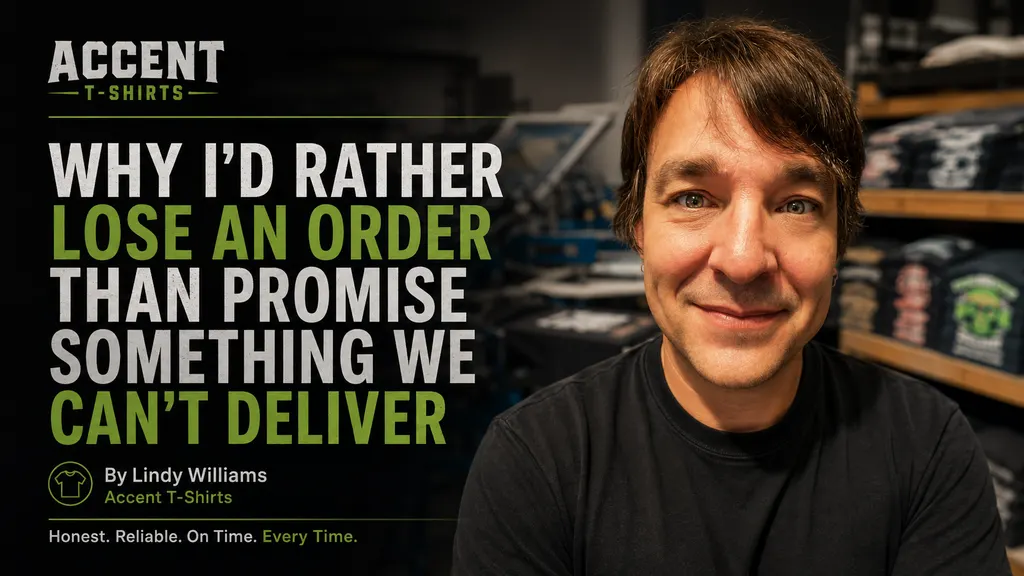
Why I’d Rather Lose an Order Than Promise Something We Can’t Deliver
By Lindy Williams, Accent T-Shirts
One of the biggest lessons I’ve learned in business is that saying yes to every customer is not the same thing as providing good customer service.
Sometimes the best thing you can do for a customer is tell them something they don’t necessarily want to hear.
At Accent T-Shirts, that sometimes means telling someone that I don’t believe we can responsibly guarantee the deadline they’re asking for. I know that can cost us an order. The customer may call another company, hear the word “yes,” and decide to go somewhere else.
I’m willing to take that risk.
I would much rather lose an order because I was honest than take someone’s money, make a promise I’m not confident we can keep, and spend the next several days hoping everything goes perfectly.
A lost order hurts for a little while. A broken promise can damage a relationship—and your reputation—for years.
I’ve been in the custom apparel business long enough to understand that what looks simple from the outside isn’t always simple once production begins. A customer might call and say, “I only need 50 shirts. Can you have them ready Friday?”
Sometimes the answer is absolutely yes.
Other times, there are a dozen things that have to happen between that phone call and Friday afternoon.
The correct shirts have to be available. The artwork has to be usable. If it isn’t, it needs to be recreated or cleaned up. Colors and print locations have to be confirmed. Sizes and quantities have to be finalized. The customer needs to approve the artwork. The garments have to arrive. The job has to fit into the production schedule.
Depending on the order, screens may have to be created, embroidery files digitized, transfers produced, or artwork separated for printing. Then the garments actually have to be decorated, inspected, counted, packed, and possibly shipped.
Every one of those steps takes time.
That doesn’t mean customers should expect excuses or that delays should simply be accepted as part of the process. It means a good print shop should understand its own production process well enough to give the customer a realistic answer before taking their money.
I’ve never liked the idea of selling the deadline first and figuring out whether we can actually hit it afterward.
There is a phrase you hear constantly in business: “We’ll make it work.”
I’ve said it myself plenty of times.
That mindset can be a great thing. Business owners and production teams solve problems every day. We move schedules around. We find replacement garments. We stay late. We look for alternative decoration methods. We work with suppliers and figure out ways to get customers what they need.
But there is an important difference between solving a difficult problem and ignoring an unrealistic situation.
There have been plenty of times when we’ve pulled off extremely tight deadlines. Everything lines up. The garments are available. The artwork is clean. The customer approves it immediately. Production has an opening, and nothing unexpected happens.
Those orders are possible.
The problem comes when you start treating the best-case scenario as though it is guaranteed.
“We can make this happen” and “I really hope we can make this happen” are not the same statement.
The customer shouldn’t have to figure out which one you actually mean.
If I have serious concerns about an order, I’d rather have an uncomfortable conversation with someone at the beginning than a much worse conversation when their deadline arrives.
Imagine someone has an event Saturday morning and contacts us Wednesday afternoon. They need 200 shirts. Their artwork isn’t ready. They aren’t completely sure about sizes. Two or three people still need to approve the design, and the exact garment they want may have to come from another warehouse.
Then they ask if we can guarantee everything will be finished Friday.
It would be very easy to say yes because we want the order.
There is always that pressure in business. You know that if you hesitate, another shop might promise it.
But I would rather explain the risks on Wednesday than explain on Friday why 200 shirts aren’t ready for an event that can’t be moved.
That doesn’t mean the conversation ends with “no.”
A good shop should look for solutions.
Maybe we change the garment to something available locally. Maybe we use a different decoration method. Maybe we produce part of the order first and finish the balance afterward. Maybe we reduce the quantity. Maybe local pickup removes the risk of shipping. Maybe there is another option that gets the customer what they actually need rather than exactly what they originally requested.
That is part of our job too.
The goal should be to solve the customer’s problem without creating an even bigger one.
There are also a lot of variables in custom printing that customers never see.
A customer sees a shirt and a logo.
We see garment availability, incoming freight, artwork resolution, color separation, ink coverage, fabric type, embroidery density, machine scheduling, production time, spoilage, quality control, and delivery.
Garments occasionally arrive damaged. A distributor can run short on a particular size. A shipment can get delayed or misrouted. Artwork that looks perfectly fine on a phone screen can turn out to be a tiny low-resolution image that won’t reproduce well.
A print can come off the press and simply not meet our standard. Embroidery may need an adjustment after a sew-out. Equipment occasionally needs maintenance. A garment can get damaged during production and need to be replaced.
Those things aren’t excuses. They are realities of producing a physical product.
The responsibility of the shop is to understand those realities and build enough time into the job to deal with them when possible.
I want enough room in the schedule to inspect an order and fix something if we don’t like it.
Because the customer shouldn’t care that 99 shirts came out perfectly if the one shirt they needed for the company president is wrong.
And they shouldn’t have to care.
That’s our problem to solve.
There is another side to this that matters even more to me.
When someone places an order with Accent T-Shirts, they aren’t just buying shirts.
They’re trusting us.
Sometimes the order is for a company convention, trade show, fundraiser, school event, grand opening, tournament, birthday, family reunion, product launch, wedding, memorial, or another event that is happening on a specific day.
To us, it may be one of many jobs moving through the shop that week.
To the customer, that event may happen once.
I think you have to remember that.
I never want someone standing at their event thinking, “I wish I had never trusted that company.”
That is a terrible outcome for the customer, and it’s a terrible way to build a business.
Some of the best customers we’ve worked with over the years didn’t begin with giant orders. The relationship might have started with a couple dozen shirts, a small embroidery order, or a few polos.
Then they came back.
Then they ordered again.
Eventually we became the company they called first.
That is far more valuable to me than squeezing every possible dollar out of the first transaction.
Long-term relationships only happen when people trust what you tell them.
If we tell someone their order is going to be finished by a certain date, I want them to believe us.
If something unexpected happens, I also believe we need to communicate it. I would much rather call a customer early and explain a problem than disappear, avoid the conversation, and hope everything somehow fixes itself.
In my experience, most customers understand that things can happen.
What people really hate is being surprised.
Silence makes a problem worse.
Communication gives you a chance to solve it.
Of course, there is another reality to running a business: sometimes you really need the order.
Every business has payroll, rent, utilities, insurance, equipment, supplies, taxes, advertising, and a long list of expenses that keep showing up whether sales are great or slow.
That creates pressure to say yes.
When business is busy, turning down a difficult job may not seem like a major decision. When things slow down, it becomes much harder.
You start telling yourself that you can probably squeeze it in. Maybe the garments will arrive early. Maybe production will move faster than expected. Maybe everyone can stay late.
Sometimes that works.
But I’ve learned that desperation is a terrible production manager.
Needing the revenue doesn’t create more hours in the day.
If the timeline truly doesn’t work, accepting the money doesn’t suddenly make it work.
In fact, some orders that look profitable can become some of the most expensive jobs you take.
If an order creates excessive overtime, mistakes, reprints, refunds, stressed employees, an angry customer, and a damaged relationship, the revenue number on the invoice doesn’t tell the whole story.
Not every dollar is a good dollar.
That doesn’t mean I’m against rush orders.
Far from it.
We do rush work when we can, and we’ve helped plenty of people get out of difficult situations over the years.
Sometimes another vendor let them down. Sometimes someone forgot to order. Sometimes an event moved. Sometimes an opportunity came up unexpectedly and they suddenly need apparel.
Things happen.
If we believe we can realistically help, we’re going to try.
But I believe there should be honesty about what a rush order requires.
Artwork may need to be approved immediately. Payment may need to happen right away. Garment choices may be limited to whatever is currently available. Changes may no longer be possible after approval. Shipping can create additional risk.
If those conditions are clear and the customer understands them, then everyone is making the decision with the same information.
That is completely different from telling someone there is no risk when you know there is.
Quality also doesn’t stop mattering because someone needs the order quickly.
If our name is attached to a job, I still want it to look right.
Meeting a Friday deadline doesn’t mean much if the prints are crooked, the artwork is blurry, or the embroidery should have been adjusted.
You can deliver bad shirts exactly on time and still lose the customer.
I’d rather make sure we have enough time to do the job properly.
I also don’t believe any business should pretend that it never makes mistakes.
We make mistakes. Every company does.
What tells you something about a business is what happens afterward.
Do they answer the phone?
Do they acknowledge the issue?
Do they try to find a solution?
Do they take responsibility when the mistake is theirs?
Customer service is easy when everything goes perfectly. You really find out what kind of company you’re dealing with when something goes wrong.
And whenever possible, the best mistake is still the one you prevent by being realistic in the first place.
Accent T-Shirts has been around for a long time, and that matters to me.
You don’t keep a business going year after year because of one giant order. You do it because customers come back. They refer other people. They trust you with larger projects. Companies know they can call you again when the next event comes around.
That reputation is worth more than one transaction.
I think businesses sometimes become so focused on getting a customer to say yes that they forget about what happens afterward.
The goal shouldn’t simply be getting the order.
The goal should be making the customer happy that they gave you the order.
There is a big difference.
When someone works with Accent T-Shirts, I want them to know that we are going to try to help. We’re going to look for solutions. We’re going to communicate. We’re going to be realistic about deadlines, and we’re going to tell you when we see a potential problem.
If I believe making a promise would be irresponsible, I’m willing to lose the order rather than tell someone something I don’t believe.
That doesn’t mean everything will always go perfectly. No honest company can promise that.
It means the promise itself matters.
When you tell a customer, “We’ve got you,” those words should mean something.
At the end of the day, I’m not trying to build a collection of individual orders. I’m trying to build customers.
I want the company that orders 24 shirts today to still be calling Accent T-Shirts five or ten years from now. I want the person who gives us a small job to remember us when their company needs 500 shirts later.
That only happens if the trust survives the first order.
Sometimes earning that trust means saying yes and finding a way to pull off something difficult.
Sometimes it means offering a different solution.
And once in a while, it means saying, “I don’t think we should promise you something we aren’t confident we can deliver.”
Another company may say yes.
They may even pull it off.
If they do, good. I genuinely want the customer’s event to be successful.
But I will never believe that winning an order is more important than being truthful about what we can realistically accomplish.
Business has taught me a lot over the years, but one lesson keeps coming back to me:
Your word has value.
Every time you make a promise to a customer, you put some of that value on the line.
Keep those promises consistently, communicate when things change, and your word becomes worth more.
Break enough of them, and eventually the promises stop meaning anything.
I’d rather protect that trust—even if once in a while it costs me an order.
There will always be another order.
Rebuilding a reputation is a lot harder.

Written by Lindy Williams, Founder of Accent T-Shirts
Lindy Williams is the founder and owner of Accent T-Shirts in Las Vegas, Nevada, a custom apparel and promotional products company he started in 1999. With more than 25 years of hands-on experience in screen printing, embroidery, custom apparel, branded merchandise, and promotional products, Lindy has worked with everyone from local businesses and schools to large corporate and event clients. His approach to business is simple: be honest, communicate clearly, do quality work, and build relationships that last longer than a single order. In addition to running Accent T-Shirts and Race Day Outfitters, Lindy is also a musician, songwriter, and creative entrepreneur who has spent much of his life building businesses, making music, and turning ideas into something real.