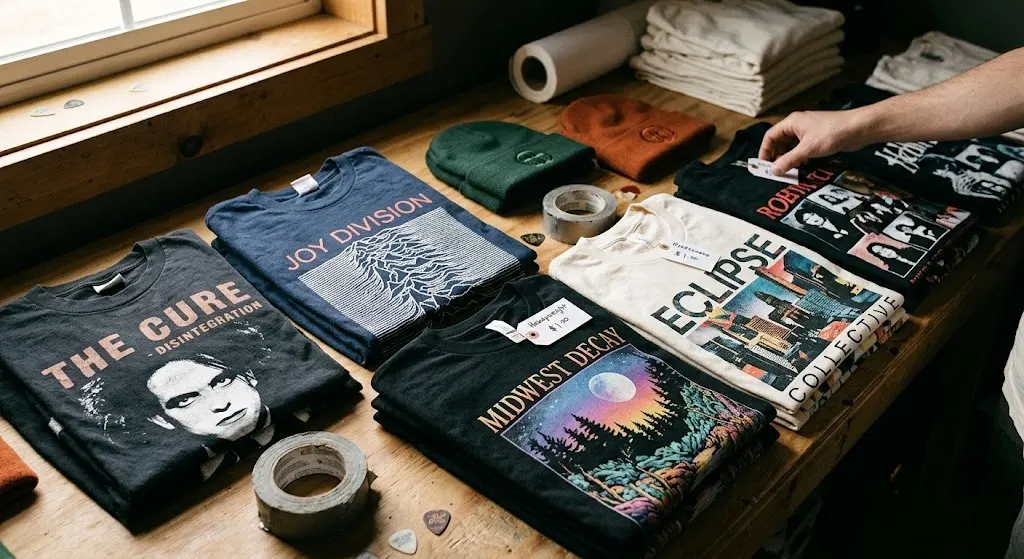
If you walked into an alternative record shop or concert venue in 1985, band merchandise was a straightforward, almost industrial business. If you were seeing The Cure, Joy Division, or Bauhaus, you stood in a cramped queue near a single folding table, handed over cash, and walked away with a heavy black cotton tee stamped with a high-contrast white screen print. It was simple, functional, and durable. Merch served as a visual passport for subculturesâa uniform that signaled to fellow weirdos, goths, and post-punk fans that you belonged to the same underground tribe.
Jump forward to 2026. The alternative sceneâfrom modern emo, Midwest emo revival, and post-hardcore to shoegaze and indie rockâoperates under a completely transformed paradigm. Merch is no longer just a concert souvenir or a side project for bands; it is the financial backbone of the entire independent music ecosystem. Driven by the realities of streaming economics, the explosion of direct-to-consumer e-commerce, and radical advances in garment decoration technology, band apparel has evolved from basic printed t-shirts into fully realized lifestyle apparel.
How did alternative band merchandise transition from simple one-color venue runs in the 1980s to the complex, high-margin, small-batch pre-orders of today? More importantly, what can modern bands, apparel brands, and event organizers learn from this evolution to print higher-quality garments and maximize their revenue?
1. The 1980s Post-Punk Model: Scarcity, DIY, and Mass Speculative Runs
To understand modern merchandise strategy, we first have to examine the constraints and aesthetic choices of the 1980s post-punk and goth pioneers.
The Era of Physical Scarcity
In the 1980s, direct-to-consumer shipping did not exist in any modern sense. Unless a band was signed to a major label with international retail distribution, buying a band shirt required one of two things:
- Attending a live concert performance.
- Filling out a physical order form found inside a vinyl record sleeve or fan club zine, writing a check or money order, and waiting six to eight weeks for mail-order delivery.
Because purchasing opportunities were scarce, merch possessed immense cultural currency. Wearing a vintage 1989 Cure Disintegration tour tee meant you were physically present at the venue or dedicated enough to track down mail-order releases.
High Minimums and Speculative Inventory
From a manufacturing perspective, 1980s band merchandise carried significant financial risk. Bulk screen printing in the 1980s was an analog, labor-intensive process. Creating film positives, burning mesh screens, mixing custom plastisol inks, and calibrating manual or early automatic presses required extensive setup time.
Because setup costs were high, print shops enforced large minimum order quantities (MOQs). Bands couldn't simply order 15 shirts to test a market; they had to order hundredsâor thousandsâof units upfront. Tour managers had to estimate demand across dozens of cities, committing thousands of dollars in capital upfront. If a tour underperformed, bands were left sitting on boxes of unsold inventory, tying up cash flow that was desperately needed for gas, gear, and lodging.
The Stark "Goth" Aesthetic: Born from Utility
The iconic aesthetic of 1980s alternative merchâbold, high-contrast, minimalist designs printed almost exclusively on dark garmentsâwas partially driven by artistic vision, but it was equally shaped by production constraints:
- Fewer Ink Colors: Every extra ink color required an additional screen, film positive, and setup fee. A 1-color white print on a black tee was the most cost-effective item to manufacture.
- Heavyweight Cotton: Garments of the era were typically 100% carded open-end cotton (such as classic 6.1 oz heavyweight tees). They were boxy, thick, and stiff compared to today's combed, ring-spun blends, but they provided a sturdy canvas that stood up to aggressive laundering and daily wear.
- Simplicity in Graphics: Stark line drawings, typography, album cover iconography, and high-contrast band portraits dominated. Fine photographic gradients and multi-color artwork were difficult and expensive to reproduce accurately on dark fabrics using old-school screen prep techniques.
2. The Streaming Shift: Why Merch Became the Primary Revenue Engine
To understand why 2026 emo and alternative artists treat merchandise with the discipline of a high-end streetwear brand, one must look at how music monetizes today compared to the 1980s.
The Financial Reality of Modern Streaming
In the 1980s, album sales generated direct income for artists and record labels. A successful LP sold for $8 to $10, providing a steady royalty stream that funded recording sessions and venue tours.
In the digital streaming era, music consumption has shifted to access-based subscription models. While streaming provides global reach and instantaneous discovery, payouts per stream hover around fractions of a cent ($0.003 to $0.005 per stream on average).
To contextualize this shift: To generate $40.00 in gross revenue from digital streaming, an artist needs roughly 8,000 to 10,000 streams. Alternatively, an artist can sell one custom embroidered hoodie or one heavyweight vintage-washed t-shirt at their merch table or web store.
As a result, merchandise is no longer an ancillary add-on. For independent emo, alt-rock, and hardcore acts, apparel sales directly cover touring expenses, studio time, equipment upgrades, and basic living expenses.
Merch as Identity in the Social Media Age
While 1980s subculture identity was verified in person at shows and record stores, modern alternative fans showcase their taste across digital platforms. Wearing a limited-edition drop from a modern emo artist, a shoegaze revival group, or a post-hardcore band functions as a statement of identity on social media feeds and at live events.
Modern fans view purchasing merchandise as a direct micro-donation to their favorite artists. They aren't just buying a t-shirt; they are intentionally funding the artist's ongoing career while securing a wearable piece of the band's aesthetic universe.
3. The 2026 Emo & Alternative Merch Landscape: Streetwear, Drops, and Micro-Details
Modern alternative artists no longer slap a basic JPEG onto a generic budget tee. Influenced by streetwear culture, high fashion, and digital commerce, modern emo band merch has become sophisticated, deliberate, and high-margin.
Streetwear Influence: Blanks, Fits, and Weight
Modern alt and emo audiences care deeply about the fit, feel, and silhouette of their clothing. The days of low-cost, scratchy promo tees are over. Today's artists carefully select their blank apparel to match streetwear trends:
- Heavyweight & Boxy Cuts: Vintage 1990s-style boxy fits, drop-shoulder seams, and heavyweight cotton fabrics (ranging from 6.5 oz/yd² to 8.5 oz/yd² for tees) are standard.
- Garment Dyes and Vintage Washes: Pigment-dyed tees, mineral washes, and acid washes give new garments a faded, broken-in, "vintage concert tee" look right out of the box.
- High-End Hoodies: Heavyweight fleece (400 GSM to 500 GSM), french terry lining, cross-grain cuts, and double-lined hoods are expected for premium fall/winter apparel drops.
The "Drop" Culture and Limited Pre-Orders
Borrowing strategies from streetwear giants, modern bands leverage scarcity and urgency. Instead of keeping a static online store with the same three items year-round, bands execute "Limited Merch Drops":
- Timed Pre-Order Windows: A band announces a new design available for 72 hours only. Fans must order within that window before the item is retired forever.
- Zero Inventory Risk: Because goods are sold before they are printed, the band collects capital upfront, calculates exact sizes needed, orders precise quantities from their print shop, and eliminates unsold leftover inventory.
- High Conversion Rates: Urgency pushes hesitant fans to buy immediately rather than delaying their purchase.
Comprehensive Branding & Micro-Details
Modern emo bands focus on small, elevated finishing touches that raise perceived value:
- Custom Printed Neck Tags: Removing original manufacturer tags and printing custom inner neck branding (band logo, care instructions, size) makes the garment feel like a custom apparel line rather than a generic blank.
- Woven Label Hem Tags: Small woven labels sewn onto the bottom hem or sleeve cuff add a subtle, premium accent.
- Intricate Placement: Artwork isn't restricted to center-chest prints. Modern designs feature oversized back prints, subtle left-chest micro-embroidery, full-length sleeve prints, and asymmetric placements.
4. Technology Evolution: Screen Print vs. DTF vs. DTG vs. Custom Embroidery
The shift from 1980s merch to modern 2026 apparel isn't just a change in business strategyâit is directly enabled by massive advancements in print and decoration technology available under one roof at Accent T-Shirts.
Screen Printing Las Vegas: Still the Heavyweight Champion for Volume
Screen printing remains the industry standard for high-volume tour orders, large event apparel, and bulk business shirts (typically 75+ units per design).
- Why It Lasts: Screen printing uses real liquid inks (such as soft-hand plastisol, discharge, or water-based inks) pushed directly into fabric fibers. It offers unmatched durability, vibrant color saturation, and exceptionally low cost-per-unit at high volumes.
- Evolution Since the 1980s: Modern screen printing utilizes automated presses, computer-to-screen (CTS) imaging technology, and water-based or discharge inks that leave a "zero-feel" print on soft cotton garments, eliminating the thick, rubbery print feel of older garments.
Direct-to-Film (DTF Printing Las Vegas): The Game-Changer for Small Batches & Complex Art
Direct-to-Film (DTF) printing has revolutionized custom apparel, particularly for modern independent bands, local creators, and hospitality teams running online drops or small-batch runs.
How It Works: Artwork is digitally printed using specialized inks onto a clear film sheet. A heat-activated adhesive powder is applied to the back and cured before being heat-pressed onto the garment.
Why Itâs Ideal for Modern Emo Art:
Unlimited Colors & Fine Detail: Modern emo and alt artwork frequently features complex photographic collages, painterly gradients, fine line work, and multi-color illustrations. DTF reproduces full-color CMYK photo-realistic detail effortlessly without expensive screen setups per color.
Low Minimums & Fabric Versatility: DTF transfers adhere cleanly to dark fabrics, polyester blends, 100% cotton, fleece, aprons, and synthetic materials without strict color limits.
Placement Versatility: DTF transfers apply easily to tricky locationsâsuch as hat crowns, sleeve cuffs, fleece hoodies, and collar edgesâthat are difficult to print on a traditional screen press carousel.
Direct-to-Garment (DTG Printing): Instant On-Demand Printing
Direct-to-Garment (DTG) functions like an industrial inkjet printer for clothing, printing water-based inks directly into 100% cotton fabric.
Best Application: DTG excels for ultra-soft, breathable prints on 100% high-cotton garments when executing single-unit print-on-demand fulfillment or very short runs. If a band wants to host a permanent online catalog of vintage album designs without holding inventory, DTG allows instant fulfillment.
Custom Embroidery Las Vegas: Elevating Outerwear & Headwear
Custom embroidery has become a cornerstone of modern emo and indie merch lines as well as corporate staff uniforms.
Tactile Quality: Thread-work adds immediate retail value. A subtle, tonal embroidered band logo on a heavyweight hoodie or unstructured dad hat commands a significantly higher retail price point ($45â$75) than a flat print.
Durability: Embroidery thread does not fade, peel, or crack, making it ideal for headwear (beanies, snapbacks, flexfit hats), polos, jackets, and corporate promotional gear.
5. Merch Spec Comparison: 1989 The Cure Tour Tee vs. 2026 Emo Band Drop Tee
Comparing the physical specifications of a classic 1980s tour tee to a 2026 modern release highlights how decoration techniques, blank selection, and sales models have changed over time:
1989 The Cure Tour Tee Specs
- Garment Blank: Standard 6.1 oz carded open-end cotton tee with a boxy, stiff feel and standard sewn-in manufacturer paper tags.
- Primary Decoration: 1-color white screen print centered on the front chest.
- Finishing Touches: Original manufacturer paper label.
- Sales Method: Cash only at venue merch tables or vinyl LP mail-order forms.
- Retail Price: ~$15.00 ($35.00 adjusted for inflation).
- Financial Risk: High (Bands pre-printed 2,000+ units upfront before hitting the road).
2026 Emo Band Drop Tee Specs
- Garment Blank: 7.5 oz heavyweight boxy vintage pigment-dyed ring-spun cotton tee.
- Primary Decoration: Full-color CMYK back print produced via Direct-to-Film (DTF) paired with a left-chest micro-embroidery logo.
- Finishing Touches: Custom screen-printed inner neck tag and a woven label on the sleeve cuff.
- Sales Method: Limited 72-hour online e-commerce pre-order drop.
- Retail Price: $42.00 for tees / $75.00 for heavyweight hoodies.
- Financial Risk: Zero (Items are printed local-to-order after the pre-order window closes).
6. Strategic Merch Playbook for Modern Bands, Brands, and Las Vegas Businesses
Whether you are an independent band preparing for a tour stop at a Las Vegas venue, a restaurant team outfitting staff uniforms, or a visiting exhibitor needing trade show apparel, the lessons learned from alternative merch evolution apply directly to your custom printing strategy.
1. Upgrade Your Garment Canvas
Your artwork is only as good as the garment underneath it. Modern consumersâespecially younger demographicsârarely wear cheap, scratchy promo tees. Upgrading from a basic blank to a mid-to-heavyweight combed ring-spun cotton tee or garment-dyed shirt increases customer satisfaction, wear frequency, and overall perceived value.
2. Match the Printing Method to Your Art & Quantity
Work directly with your local Las Vegas T-shirt printer to select the proper decoration method for your project:
- Use Bulk Screen Printing when you have a clean 1- to 3-color design and need a large volume of garments (75+ units) for an event, tour, or staff uniform.
- Use DTF Printing when your artwork contains multi-color gradients, photographic details, fine line work, or when you need small-to-medium runs on dark fabrics, synthetic blends, or fleece.
- Use Custom Embroidery for dad hats, beanies, polo shirts, aprons, and jackets where tactile texture and long-term durability are critical.
3. Build Urgency with Limited Drops
Instead of holding thousands of dollars in static inventory, adopt the streetwear pre-order drop model. Announce limited-time pre-order windows for new designs. This builds excitement, generates immediate cash flow, and tells you exactly how many units of each size to order from your local print shop.
4. Add Custom Finishing Touches
If you want to charge premium prices for your merchandise line or corporate apparel, invest in finishing details. Remove tear-away tags and print custom inner neck labels, add woven hem tags to cuffs, and poly-bag garments for clean distribution.
5. Partner with a Trusted Local Las Vegas Print Shop
Having a reliable local production partner ensures your artwork files are prepped accurately, PMS colors match your brand guidelines, and print orders arrive on schedule. Local print shops eliminate shipping delays and allow for easy pickup or direct venue delivery across the Las Vegas Strip, Henderson, and North Las Vegas.
Bring Your Merch Vision to Life with Accent T-Shirts
For over 27 years, Accent T-Shirts has been a trusted Las Vegas custom t-shirt printer and embroidery shop. We provide high-quality screen printing, Direct-to-Film (DTF) printing, DTG, custom embroidery, and promotional products under one roof for bands, local businesses, schools, hospitality teams, and trade show exhibitors across the Las Vegas Valley.
Whether you need a small-batch DTF pre-order drop, high-volume event screen printing, embroidered polo shirts, or rush convention apparel delivered directly to your hotel booth or venue, our experienced local press team is ready to help.
Our In-House Apparel Decoration Services:
- Custom Screen Printing: High-volume runs with vibrant, durable spot-color inks.
- DTF Printing Las Vegas: Full-color, high-definition prints with low minimums across cotton, poly, and mixed fabric blends.
- Custom Embroidery: Premium thread-work for hats, polos, aprons, jackets, and corporate uniforms.
- Promotional Items & Event Apparel: Branded giveaways, tote bags, and fast-turnaround trade show apparel for Las Vegas events.
Ready to start your next custom apparel order?
Call Accent T-Shirts today at (702) 866-8888, email team@accenttshirts.com, or request a fast digital quote online at AccentTShirts.com!