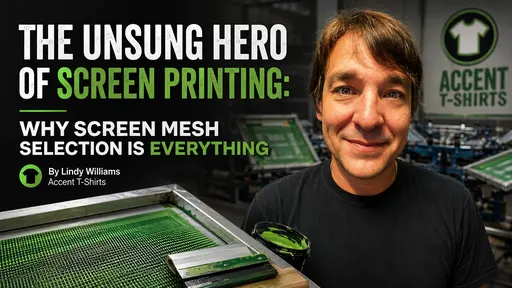
The Unsung Hero of Screen Printing: Why Screen Mesh Selection Is Everything
By Lindy Williams, Founder of Accent T-Shirts
When people think about screen printing, their minds usually jump to the splashy, creative elements: vibrant liquid inks, bold custom designs, and squeegees pulling across a press. But behind every crisp print, razor-sharp detail, and buttery-soft hand-feel lies a technical hero working quietly in the background: the screen mesh.
Mesh selection isn't just a technical detail left to the press operators—it’s the foundational control variable for the entire print run. Choose the right mesh count, and your inks flow seamlessly, fine lines stay sharp, and production stays on schedule. Choose the wrong mesh, and you’re looking at blurred edges, choked-out details, uneven ink deposits, or hours wasted battling clogged screens.
Whether you're decorating high-end apparel or running a commercial print shop, understanding screen mesh is what elevates good printing into exceptional craft.
What Is Screen Mesh, Exactly?
Screen printing mesh consists of synthetic monofilament polyester threads woven into a precise, grid-like screen mounted on an aluminum or wooden frame.
The primary metric used to measure mesh is Mesh Count—the number of individual threads per linear inch (or centimeter in metric systems). A low mesh count means fewer, thicker threads with larger openings between them. A high mesh count means many fine threads packed closely together, creating tiny openings.
LOW MESH COUNT (e.g., 110) HIGH MESH COUNT (e.g., 305) ┌───┬───┬───┐ ┌┬┬┬┬┬┬┬┬┬┬┬┬┬┐ │ │ │ │ <-- Large Openings ├┼┼┼┼┼┼┼┼┼┼┼┼┼┤ <-- Tiny Openings ├───┼───┼───┤ Thick Inks ├┼┼┼┼┼┼┼┼┼┼┼┼┼┤ Fine Details │ │ │ │ High Ink Deposit ├┼┼┼┼┼┼┼┼┼┼┼┼┼┤ Soft Hand └───┴───┴───┘ └┴┴┴┴┴┴┴┴┴┴┴┴┴┘The fundamental rule of thumb is simple: The mesh count dictates the volume of ink transferred onto the substrate.
1. Ink Deposit and Hand-Feel Control
The physical feel of a printed t-shirt—known in the industry as the "hand"—is directly tied to the amount of ink resting on top of the fabric fibers.
- Low Mesh Counts (86 – 110): These screens feature wide openings that allow thick, viscous inks (like heavy white plastisol or athletic ink) to pass through easily. They lay down a heavy layer of ink, which is crucial when printing bold white underbases on dark garments or applying thick specialty inks like glitter, puff, or shimmer.
- High Mesh Counts (230 – 305+): High mesh screens restrict ink flow, depositing only a micro-thin layer onto the garment. This creates that coveted, ultra-soft "retail feel" where the ink sits flush with the shirt rather than feeling like a plastic shield on the chest.
If you try to print a heavy white underbase through a 305 mesh, the ink won't clear, causing uneven coverage and dry screens. Conversely, if you print subtle detail or water-based inks through an 86 mesh, you’ll flood the garment with way too much ink, ruining the shirt's feel and risking severe bleed.
2. Image Resolution and Detail Retention
Detail in screen printing comes down to how accurately your mesh holds microscopic halftone dots and line work from your film positive.
When printing photorealistic prints, simulated process designs, or delicate typography, the image relies on halftone screens (measured in Lines Per Inch, or LPI). To prevent halftone dots from falling into the holes of the mesh or getting lost behind a thread, printmakers follow the 1:4 to 1:5 Rule:
{Mesh Count} {LPI} times 4.5For example, if your artwork is prepped at 55 LPI, you need a mesh count of at least 250 to 305 to resolve those dots accurately. Using a lower mesh count causes a phenomenon known as "dot gain" or loss of tonal range, turning a detailed gradient into a solid, muddy splotch.
3. The Great Mesh Spectrum: Matching Mesh to Application
To help navigate the press floor, here is a breakdown of standard mesh counts and their ideal decoration uses:
| Mesh Count Range | Characteristics | Best Uses & Ink Types |
| 86 – 110 Mesh | Maximum ink flow, wide thread openings | Specialty inks (glitter, shimmer, metallic), heavy athletic prints, thick block lettering on dark fleece. |
| 156 Mesh | The all-purpose workhorse | Standard spot-color prints, dark garment underbases, solid text, medium-weight plastisol and water-based inks. |
| 200 – 230 Mesh | Fine detail, controlled ink deposit | Fine-line artwork, softer hand-feel prints, light garment printing, simulated process underbases. |
| 305 Mesh & Above | Minimum ink flow, extreme detail | Four-color process (CMYK), high-density halftone gradients, discharge printing, ultra-soft retail prints. |
4. Thread Diameter & Mesh Tension: The Hidden Variables
Selecting the mesh count is only half the battle; thread diameter and screen tension complete the equation.
Thread Diameter (S vs. T Threads)
Mesh threads come in different thicknesses (typically denoted as Thin 'T' or Standard 'S'). Thinner threads create larger open areas between the weave at the same mesh count, allowing for better ink clearing and lower print pressure on press, which preserves detail and reduces operator fatigue.
Screen Tension (Newtons per Centimeter - N/cm)
A high-count mesh is useless on a loose, sagging frame. Proper screen tension (typically 20–35 N/cm) ensures:
- Accurate Registration: Loose screens stretch under squeegee pressure, causing multi-color prints to misalign.
- Clean Snap-Off: High tension allows the mesh to snap off the garment immediately behind the squeegee blade, shearing the ink cleanly for sharp edges instead of smearing.
Master the Foundation, Master the Print
Screen printing is an intricate dance between chemistry, physics, and visual art. While ink colors and graphic design get all the glory, screen mesh is the silent conductor ensuring the entire system works in harmony.
Understanding mesh selection allows printmakers to troubleshoot problems before they reach the press, reduce setup waste, and deliver decorated apparel that looks sharp, feels fantastic, and stands the test of time. Never underestimate the grid!
Written by Lindy Williams, Founder of Accent T-Shirts
Lindy Williams is the founder and owner of Accent T-Shirts in Las Vegas, Nevada, a custom apparel and promotional products company he started in 1999. With more than 25 years of hands-on experience in screen printing, embroidery, custom apparel, branded merchandise, and promotional products, Lindy has worked with everyone from local businesses and schools to large corporate and event clients. His approach to business is simple: be honest, communicate clearly, do quality work, and build relationships that last longer than a single order. In addition to running Accent T-Shirts and Race Day Outfitters, Lindy is also a musician, songwriter, and creative entrepreneur who has spent much of his life building businesses, making music, and turning ideas into something real.