Knowledge
The Las Vegas Apparel Printing Buyer’s Guide: How to Choose Screen Printing, Embroidery, DTF, or DTG (and Get It Right the First Time
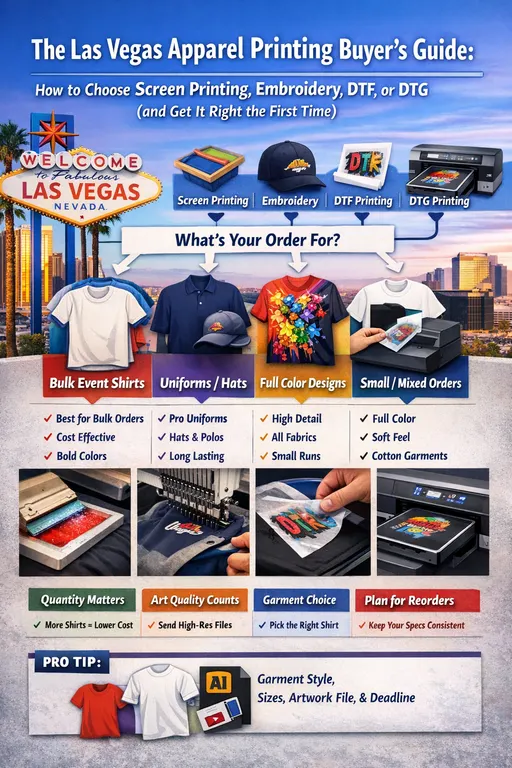
Ordering custom apparel should feel easy—pick a shirt, add your logo, done. In real life, the “best method” depends on your design, garment, deadline, and how you want the final piece to feel and last. This guide breaks down screen printing, embroidery, DTF, and DTG in plain English so you can choose the right option, avoid common mistakes, and get consistent results for events, uniforms, merch drops, and reorders.
If you’ve ever ordered custom shirts and thought, “Why does this quote feel higher than expected?” or “Why doesn’t my design look like the mockup?”—you’re not alone. Custom apparel can be simple, but only when the method matches the job.
At AccentTShirts.com, we help Las Vegas businesses, event planners, teams, and brands choose the right production method every day. The truth is: there isn’t one “best” printing option. There’s the best option for your design, your garments, your deadline, and your goals—whether that’s a clean uniform logo, a convention giveaway tee, or a premium merch drop people wear for years.
This guide will help you confidently decide between:
- Screen printing (silk screening)
- Embroidery
- DTF (Direct-to-Film)
- DTG (Direct-to-Garment)
…and avoid the common mistakes that cause delays, reprints, or disappointing results.
Step 1: Know Your Goal (This Matters More Than People Think)
Before we talk about ink and thread, answer these four questions:
- What is the apparel for?
- Event giveaway? Staff uniform? Brand merch? Fundraiser? Sports team?
- How many pieces do you need?
- 12 pieces vs 120 vs 1,200 can change the smartest method.
- How will it be worn and washed?
- Daily uniforms demand durability. A one-night event shirt can be different.
- What matters most: feel, color pop, detail, or cost?
- You can usually optimize for 2–3 of these, but rarely all four at once.
Once you know your goal, choosing the method gets way easier.
Quick Decision Guide (Use This as a Shortcut)
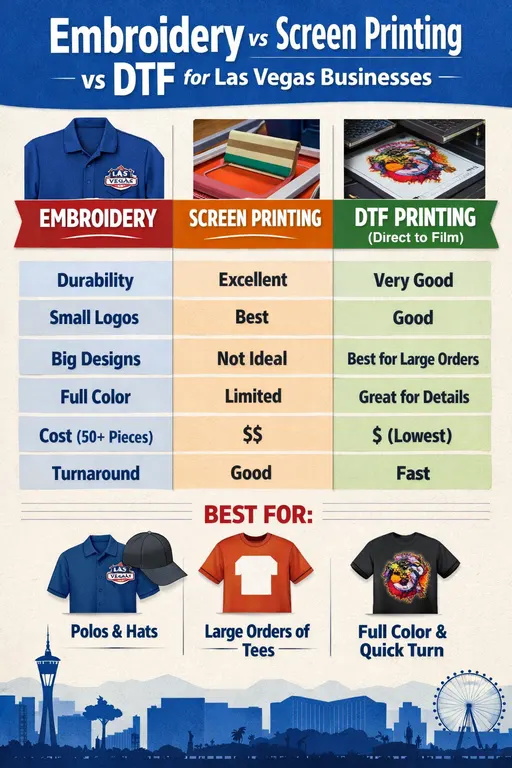
Choose Screen Printing if:
- You need bulk quantities (usually 24+ / 48+ / 100+)
- You want the lowest cost per shirt at scale
- Your design has solid colors (1–6 colors is common)
- You want a classic print look and long-lasting durability
Choose Embroidery if:
- You want a professional uniform look
- You’re doing polo shirts, hats, beanies, jackets, or bags
- You want a premium, textured finish that holds up for years
- Your logo is simple enough to stitch cleanly
Choose DTF if:
- You need high detail (gradients, small text, photo-like art)
- You have smaller quantities or mixed sizes/colors
- You want consistent results across many garment types
- You want fast turnaround without the complexity of screen setups
Choose DTG if:
- You’re printing full color on specific cotton shirts
- You want a soft feel for certain designs
- You’re ordering smaller runs and the garment type is compatible
If you’re not sure, don’t stress—keep reading and you’ll know exactly what to pick.
Screen Printing (Silk Screening): The Workhorse for Bulk Orders
Screen printing is the classic, high-volume method you’ve seen forever. Each color is typically pushed through a screen onto the garment. It’s reliable, scalable, and extremely cost-effective when your quantities are higher.
Best for:
- Company tees for teams and staff
- Event shirts (runs, tournaments, festivals, conventions)
- Simple to moderately complex logos
- Bulk orders where cost per piece matters
What screen printing does really well
1) Cost per piece drops as quantity goes up.
Screen printing has upfront setup steps (art setup, screens). Once it’s running, printing 100 shirts is efficient.
2) Bold, clean colors.
Solid spot colors look crisp and intentional—especially with well-prepped artwork.
3) Great durability.
A properly cured screen print holds up wash after wash.
What catches people off guard
1) “Art ready” vs “print ready.”
A PNG on a white background might look fine on a screen, but screen printing often requires clean vectors or proper separations. If your art needs work, that’s normal—but it affects timeline.
2) Dark shirts often need an underbase.
Printing bright colors on black or navy usually needs a white underbase layer. That can add steps and sometimes cost, but it’s how you get that pop.
3) Tiny details and gradients can be tricky.
Some gradients or ultra-fine detail can be done with screen printing (halftones), but it must be set up correctly.
When screen printing is the best choice in Las Vegas
If you’re doing event merchandise in Las Vegas, screen printing is often the top pick for 48+ pieces because you’ll get solid quality at a strong price point—especially if your design is built for it.
Embroidery: The “Polished Uniform” Standard
Embroidery isn’t ink—it’s thread. If you want something that looks official, long-lasting, and “company-approved,” embroidery is hard to beat.
Best for:
- Polos, button-ups, outerwear, hoodies
- Hats and beanies
- Work uniforms (construction, hospitality, security, offices)
- Logos that need a clean corporate feel
What embroidery does really well
1) Premium perception.
A stitched logo on a polo or hat looks professional instantly.
2) Durability.
Embroidery holds up extremely well across repeated washing and daily wear.
3) Great for texture and dimension.
You can even do 3D puff on hats when the design allows.
What catches people off guard
1) Small text can fail.
Thread has physical thickness. A logo that looks sharp at 1” wide on a website might turn into a blob when stitched small. The solution is often simplifying or slightly thickening certain elements.
2) Digitizing matters (a lot).
Digitizing isn’t just converting a file—it’s “programming” the stitch path. Quality digitizing = clean edges and readable detail.
3) Placement and sizing make or break the look.
Most left-chest logos look best around 3.25"–4.25" wide, depending on the logo and garment. Going too big can look awkward fast.
When embroidery is the best choice in Las Vegas
If you’re building a team look—especially for hospitality, security, trade show staff, office staff, and contractors—embroidered polos and hats are a smart investment. It photographs well, wears well, and signals “legit business.”
DTF (Direct-to-Film): The Swiss Army Knife for Modern Orders
DTF has become a favorite because it’s flexible. The design is printed to a film and transferred onto the garment using heat and pressure. Done correctly, it’s vibrant, detailed, and consistent.
Best for:
- Full color designs, gradients, and detailed logos
- Small runs or mixed orders (various shirt styles/colors)
- Designs with small text or more complexity
- Quick-turn jobs where consistency matters
What DTF does really well
1) Great detail.
Fine lines, shading, even photo-like prints can look strong.
2) Works on many garment types.
DTF can be used across different blends and apparel styles more reliably than people expect.
3) Great for small batches without heavy setup.
If you’re doing 12–36 shirts with full color art, DTF can be a very smart choice.
What catches people off guard
1) Feel depends on design coverage.
A small left chest logo will feel light and flexible. A huge full-front full-color print will naturally feel more “graphic” because there’s more material laid down.
2) Quality varies by process.
Not all DTF is equal. Settings, materials, and application matter. Done right, it’s clean and durable.
When DTF is the best choice in Las Vegas
If you want fast, consistent, high-detail results (especially with mixed garments or small-to-mid quantities), DTF is often the winner—particularly for convention shirts, band merch, and detailed logos.
DTG (Direct-to-Garment): Great—When the Shirt and Art Are Right
DTG prints directly onto the garment, like an advanced inkjet for fabric. It can look incredible with the right garment and proper process.
Best for:
- Full color art on compatible cotton garments
- Smaller batches
- Designs where you want a softer, “printed into the shirt” style
What DTG does really well
1) Soft hand feel (in the right scenario).
Especially on light garments with the right art.
2) Photoreal-style prints (when compatible).
DTG can produce beautiful full-color images under the right conditions.
What catches people off guard
1) Garment compatibility matters.
Not every shirt prints the same with DTG. Fabric type, finish, and how the garment is made all affect results.
2) Pretreatment and process are everything.
DTG requires the right prep to avoid dull prints or wash issues.
When DTG is the best choice in Las Vegas
DTG is excellent when you’re using the right cotton garments and want full color with a softer aesthetic—especially for smaller runs and designs where screen printing isn’t practical.
“What’s the Cheapest?” The Real Cost Drivers in Custom Apparel
Most people focus on the print method first, but these factors often affect cost just as much:
1) Quantity
- Screen printing usually wins at scale
- DTF/DTG can be great for smaller runs
2) Number of print locations
- Front only vs front + back vs sleeves
Every location adds setup/time/material—plan this intentionally.
3) Garment choice
A $2 promo tee and a $9 premium tee can both be printed beautifully, but the final product feels very different. Premium blanks often lead to higher satisfaction and repeat wear.
4) Artwork readiness
Clean vector logos reduce time and headaches. Low-res images can still be usable—but may require cleanup.
5) Deadline
Rush jobs are possible, but when your timeline is tight, the “best method” might be the one that produces consistent results fastest.
The Most Common Mistakes (and How to Avoid Them)
Mistake #1: Sending a tiny screenshot as the “logo”
Fix: Send the original logo file if you have it. If you don’t, send the highest quality version you can and we’ll guide you.
Mistake #2: Choosing the method based on what you heard once
Fix: Use the decision guide in this post. Your friend’s experience might not match your design or shirts.
Mistake #3: Not thinking about placement on different fits
Fix: Women’s cuts, youth sizes, and tall sizes can require adjustments. “One placement for all” can cause prints to land too low or too high.
Mistake #4: Ignoring shirt color + design color contrast
Fix: Great designs consider shirt color from the start. A charcoal tee needs a different approach than a white tee.
Mistake #5: Not planning for reorders
Fix: If you’ll reorder, lock your garment brand/SKU and save your print specs. That’s how you keep consistency.
What to Send Your Printer (Copy/Paste Checklist)
If you want the smoothest quote and fastest turnaround, send this information:
Apparel Details
- Brand + style (or ask us to recommend)
- Shirt color(s)
- Sizes and quantities
- Any special notes (ladies fit, youth, tall, etc.)
Artwork
- Best file you have (AI, EPS, PDF vector ideal; PNG works if high-res)
- Any brand colors (Pantone/HEX if important)
- Tell us if you want it matched “close” or “exact”
Print Specs
- Method preference (if you have one)
- Print location(s): left chest, full front, full back, sleeve, etc.
- Approx size: “3.75” wide left chest” or “11” wide full front”
- Deadline and event date
- Delivery/pickup preferences
Bonus tip: If your order is for a trade show or event, tell us the date and the “must-have-in-hand” date. Shipping and supply delays happen—planning helps.
Consistency Guide: How to Make Reorders Match Every Time
Nothing is worse than ordering “the same thing” twice and getting something slightly different.
Here’s how to keep it consistent:
- Lock your garment SKU
Same brand, same style, same color code. - Save your art file + proof
Keep the approved proof and final art. - Document print size and placement
Example: “Left chest 3.75” wide, 3” down from collar on adult L.” - Keep method consistent
A logo done in embroidery will look different than the same logo in DTF. That’s normal—just don’t mix methods unless that’s intentional. - Stick to the same color system
Pantone for screen print colors is helpful when exact brand matching matters.
Real-World Scenarios (So You Can Pick Fast)
Scenario A: 150 event shirts, 2-color logo, needed for a weekend event
Best fit: Screen printing (cost-effective, durable, fast in volume)
Scenario B: 24 staff polos + 24 hats with a company logo
Best fit: Embroidery (professional uniform look)
Scenario C: 36 shirts with a full-color design and small text
Best fit: DTF (detail + consistency)
Scenario D: 12 shirts, full-color front graphic, soft feel priority, cotton shirts
Best fit: DTG (if garments are compatible) or DTF (for broad compatibility)
Final Takeaway: The “Best Method” Is the One That Matches the Job
When you match the method to the purpose, you get:
- Better-looking apparel
- Fewer surprises
- Faster production
- More consistent reorders
- Happier customers / staff / event attendees
If you’re in Las Vegas and want a smooth process, the fastest way to get started is to send your quantity, deadline, garment preference (or ask for recommendations), and your artwork. We’ll guide you to the method that fits your goals and budget.